
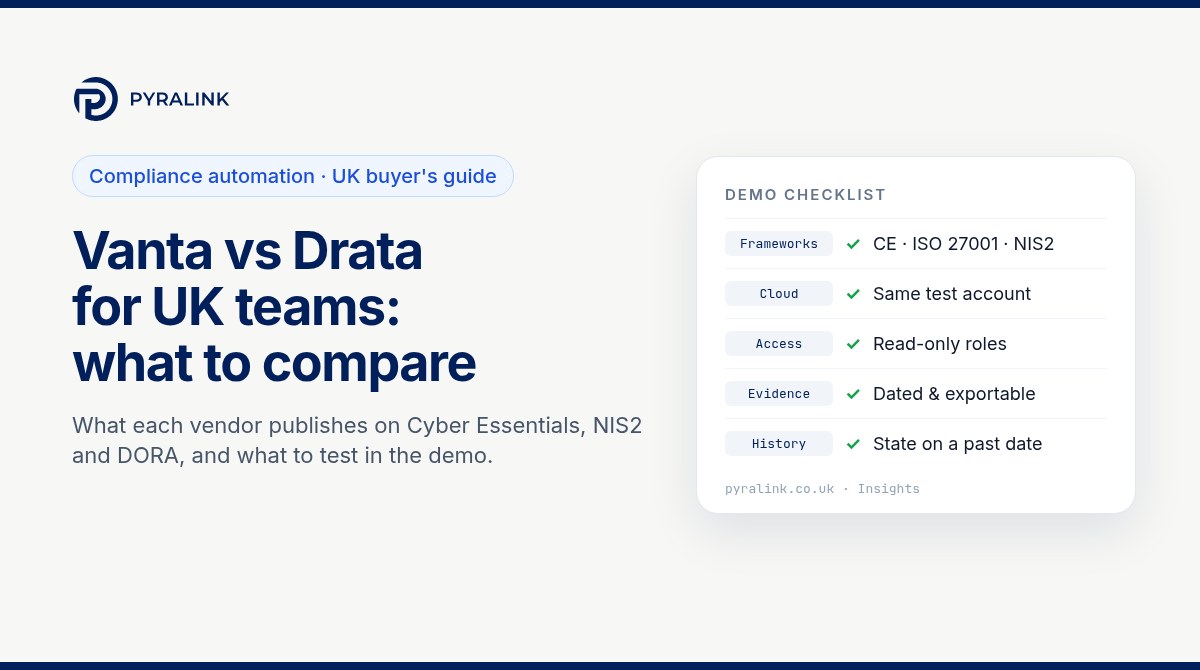
Short answer: Vanta and Drata are both broad compliance automation platforms, and on their own public pages they look closer than most comparison posts suggest. Both list SOC 2, ISO 27001, Cyber Essentials, NIS 2 and DORA, both describe continuous control monitoring, supplier risk workflows and a Trust Center, and neither issues your Cyber Essentials certificate. For a UK team the useful differences are how each one structures controls across frameworks, how well each handles the specific UK and EU obligations you face, and whether the cloud evidence it produces is something your assessor can check for themselves. Shortlist on scope, then test both against the same framework list and the same cloud accounts.
This guide sticks to what each vendor publishes about itself, checked on 9 November 2026, and adds the questions UK buyers should ask that feature tables tend to skip. We make PyraLink™ Prove, a narrower read-only cloud evidence product, so we say plainly where it fits and where it does not. Product names are trademarks of their owners.
Vanta vs Drata at a glance
Every entry below comes from the vendor's own website. Where a page did not cover a point, we say so rather than guess.
| Topic | Vanta | Drata |
|---|---|---|
| How it describes itself | An "Agentic Trust Platform" for compliance, risk, third-party risk, AI governance and a Trust Center. | A platform that helps teams "centralize evidence, map controls, and automate continuous monitoring", with third-party risk and a Trust Center. |
| Framework library | Its frameworks page lists SOC 2, ISO 27001, GDPR, Cyber Essentials, NIS 2, DORA, ISO 27017, ISO 27018, ISO 42001, EU AI Act, BSI C5 and many US frameworks, plus custom frameworks. | Its frameworks page says "30+ pre-built frameworks", including SOC 2, ISO 27001, GDPR, Cyber Essentials, NIS 2, DORA, ISO 27017, ISO 27018, ISO 42001 and EU CRA, plus custom frameworks. |
| Cyber Essentials | Supports Cyber Essentials and Plus preparation; states it "does not issue the certificate" and connects customers with certification partners. | Maps Cyber Essentials requirements into a "control-centric structure" and extends those controls to supplier assessments. |
| Monitoring | Says it "watches your environment in real time and reports back every hour". | Says it continuously monitors Cyber Essentials controls to detect gaps. |
| Cross-framework reuse | Shows evidence reuse from Cyber Essentials into other frameworks, with NIST 800-171, HIPAA and US Data Privacy as the examples. | Keeps Cyber Essentials "aligned with other frameworks without maintaining separate documentation". |
| Trust Center | Yes, including showing Cyber Essentials status to prospects. | Yes, including publishing Cyber Essentials documentation. |
Sources: Vanta Cyber Essentials page and Drata Cyber Essentials page, both checked 9 November 2026. Vendor pages change; confirm anything that matters to your decision in the demo.
Where the two genuinely differ
How controls are organised
Drata's language is consistently about a single control set: requirements from each framework are mapped onto shared controls, with owners and evidence attached once. Vanta's pages emphasise framework mapping and evidence reuse, showing how much of a new framework is already covered by work you have done. In practice both aim to stop you collecting the same evidence twice. The real test is your own overlap: ask each vendor to show your current frameworks side by side and point to the controls that still need separate evidence.
Which overlaps are shown for UK teams
On its Cyber Essentials page, Vanta's reuse examples are US frameworks. That does not mean UK and EU mappings are missing, since its library includes ISO 27001, NIS 2 and DORA, but if your obligations are Cyber Essentials, ISO 27001 and NIS2 you should ask to see that exact combination. Drata's Cyber Essentials page leans towards supplier assurance, describing how to assess third parties against Cyber Essentials, which matters if you buy from many small UK suppliers.
Monitoring cadence
Vanta publishes an hourly cadence. Drata says "continuously" without a published interval on the pages we checked. Neither number tells you how often a given cloud test runs for your accounts, so ask for the frequency per integration you plan to connect.
What neither platform does for you
- Issue your Cyber Essentials certificate. According to the NCSC, certification runs through IASME: your self-assessment answers are signed off by a board member or equivalent and marked by an assessor, and Cyber Essentials Plus adds independent technical testing. Software prepares you; the certification body decides. The current question set is stricter on MFA and patching, as covered in our guide to Cyber Essentials Danzell evidence requirements.
- Decide whether NIS2 applies to you. NIS2 is an EU directive. UK organisations usually meet it through EU operations or as suppliers to entities in scope. Either platform can hold the controls, but the evidence still comes from your own estate; our NIS2 cloud compliance checklist lists what that looks like on AWS, Azure and Google Cloud.
- Configure your cloud. Under the shared responsibility model you own how identities, logging, storage and networks are set up. A platform can only report on the accounts, subscriptions and projects you connect, so coverage gaps in your connections become gaps in your evidence.
A UK buyer's checklist for Vanta and Drata demos
Run both evaluations the same way, or the comparison tells you more about the demo than the product.
- Write your framework list first. For example Cyber Essentials or Cyber Essentials Plus, ISO 27001, SOC 2 and NIS2. Ask each vendor to show those frameworks inside the product, not on a slide.
- Connect the same test cloud account to both trials. Use one AWS, Azure or Google Cloud account with known misconfigurations and compare which tests run, which fail, and how each maps a failure to your frameworks. Our list of common cloud misconfigurations is a good seed set.
- Ask for the exact cloud permissions. Prefer read-only roles. Get the permission list in writing and have your cloud owner review it.
- Ask how evidence leaves the platform. What formats, whether each item carries a collection date, and whether an assessor can check an exported item without a login to the vendor's system.
- Ask for history, not just status. A Type 2 or surveillance audit asks whether a control was in place across a period. Check you can show the state of a control on a past date.
- Check the Cyber Essentials route. Which certification partners each vendor works with, and how the platform handles the current question set for the account you will register.
- Ask where evidence is stored. Under UK GDPR you should know where screenshots, user lists and configuration exports containing personal data are held.
- Get written quotes for the same scope and term. Headline packages differ, so compare the total for your frameworks, add-ons and headcount.
- Ask for a UK reference at your size and a sample Trust Center page.
Where PyraLink™ Prove fits
If you need a full compliance programme, with policies, employee acceptance, access reviews, supplier risk and a public Trust Center, Vanta or Drata cover more ground than PyraLink Prove. We would rather say that up front.
PyraLink Prove does one part of the job. It connects to AWS, Azure and Google Cloud with read-only access, checks Microsoft 365 and Google Workspace read-only, and maps each check to ISO 27001, SOC 2, Cyber Essentials, NIS2 and DORA. Each result is kept as digitally signed, dated evidence records that you can verify independently, so an assessor can check a record without access to the platform. Reports export as JSON, CSV, PDF and HTML, so they can be attached as evidence wherever you run your compliance programme, including alongside either platform above.
For fact-checked, side-by-side tables, see PyraLink Prove vs Vanta, PyraLink Prove vs Drata and the full comparison hub, which also covers Wiz. For the wider case against screenshot folders, read multi-cloud compliance auditing with one scan.
Frequently asked questions
Is Vanta or Drata better for Cyber Essentials?
Both publish dedicated Cyber Essentials support and neither issues the certificate; that is done through IASME and its licensed certification bodies. Vanta's page focuses on prescriptive controls, hourly monitoring and certification partners, while Drata's focuses on a shared control structure and supplier assessments. Choose on workflow fit after testing both with your own accounts.
Do Vanta and Drata support NIS2 and DORA?
Yes. Both list NIS 2 and DORA on their framework pages as of 9 November 2026. Support means mapped controls and templates; you still need evidence from your own systems and a view on whether you are in scope.
Is Vanta vs Drata the same decision as choosing a cloud security platform?
No. Compliance platforms track controls against frameworks. Cloud security platforms such as Wiz focus on finding and prioritising risk across large cloud estates. See PyraLink Prove vs Wiz for how that category differs.
What should we compare besides features?
The cloud permissions each tool needs, how evidence is exported and dated, whether you can show a control's state on a past date, where evidence is stored, and a written quote for the same scope and term.