
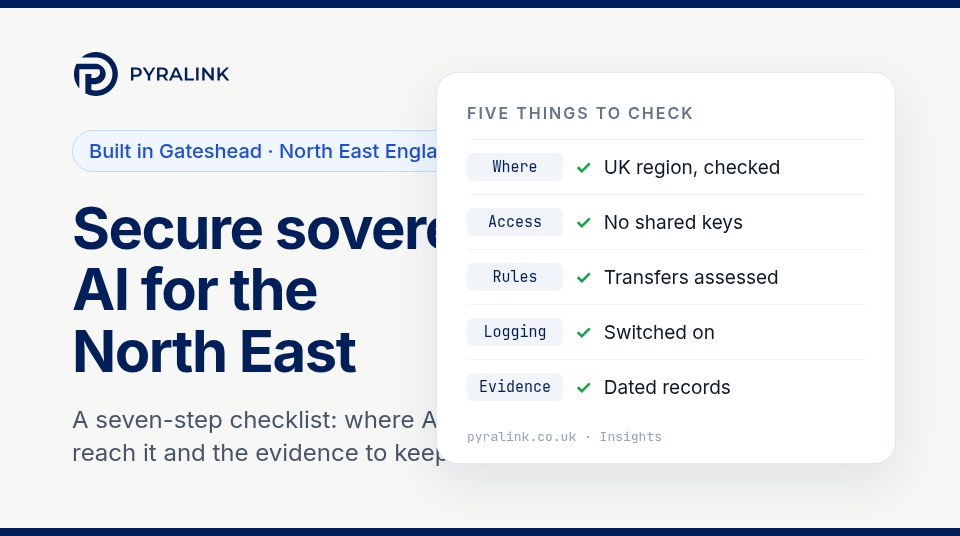
Short answer: secure sovereign AI means you decide where your AI runs, who and what can reach it, and which laws and contracts apply, and you can show dated proof that those decisions still hold. For an organisation in Gateshead, Newcastle or anywhere in North East England, the practical route is usually to run AI inside a cloud account you already control, in a UK region, with private networking, no long-lived keys, logging switched on and a written record of your choices. A UK region on its own is not enough, because some deployment types can process prompts elsewhere.
This checklist is for North East organisations whose customers, auditors or insurers have started asking how they use AI. It is written in Gateshead by Pyralink, the company behind PyraLink™ Prove, and it follows the same seven steps whether you are a manufacturer on the Tyne, a professional firm in Newcastle or a supplier to the public sector. It is general guidance, not legal advice.
What sovereign AI means for an organisation
The UK government uses the phrase at national level. Its Sovereign AI programme, backed by up to £500 million, aims to help UK AI companies start in Britain and scale here. A government sector study defines sovereign AI capability as the ability to access, develop or control key elements of the AI ecosystem, including infrastructure, data, models, talent and supply chains.
An organisation does not need to build a model to apply the same idea on a smaller scale. Four questions cover most of it:
- Where does it run? Which country and which provider, and which deployment type or inference route.
- Who can reach it? People, applications, suppliers and the provider itself.
- What rules apply? UK GDPR transfers, customer contracts and any sector rules you work under.
- Can you prove it? Settings change. A screenshot from March does not show what is true in November.
Step 1: find where AI is already being used
Before choosing a platform, list what already exists. Public chatbots, AI features switched on inside software you already pay for, a developer's test model in a spare cloud subscription and browser extensions all count. Ask each team lead three things: which tools, what data goes in, and who approved it. Our guide to shadow AI discovery and governance goes into this in more detail.
Step 2: decide what data may go where
Write a short rule in three tiers. Information that may go into any approved AI tool, information that may go only into AI running in your own cloud account, and information that must never go into AI at all, such as credentials or special category data you have no lawful basis to process this way. A one-page rule that staff can remember beats a long policy nobody reads.
Step 3: choose where the AI runs
For most organisations there are three realistic choices. A public chatbot is quick but gives you the least control. An AI model hosted inside your own cloud account, such as Azure OpenAI or Amazon Bedrock, keeps prompts and responses within an environment you configure. Self-hosting your own model gives the most control and the most work. The middle option is the usual starting point for small and mid-sized organisations.
If you choose a UK region, check the deployment type as well. Microsoft's deployment types for Foundry Models include Global and Data Zone options that can process prompts outside the UK, while Standard and Regional options in a UK region, where the model is available, keep processing in that region. Our Azure OpenAI security checklist and Amazon Bedrock security checklist show the settings to check on each platform.
Step 4: check the contract and the law
If personal data goes to a provider outside the UK, the ICO's guidance on restricted transfers says the transfer must be covered by UK adequacy regulations, appropriate safeguards or an exception, and that using a safeguard means completing a transfer risk assessment first. The ICO's AI audit toolkit also expects written contracts that identify who is controller and who is processor and describe the processing. Ask your AI provider for the sub-processor list and the locations where data is processed, and keep their answers with your records.
Step 5: lock down access
AI incidents often begin with ordinary weaknesses: an API key in a code repository, a model endpoint open to the internet or an over-broad role. The National Cyber Security Centre's guidelines for secure AI system development treat security as a requirement across design, development, deployment and operation. In practice, that means identity-based access instead of shared keys, narrow roles, private network paths and a clear owner for every AI resource. Stolen credentials used to run up model bills are covered in our article on LLMjacking and owning your AI bill.
Step 6: switch on logging and alerts
If you cannot see who called a model, from where and when, you cannot investigate a problem or answer a customer's questionnaire. Turn on the provider's diagnostic or invocation logging, protect the log store from deletion, and set an alert for unusual spikes in use or cost.
Step 7: keep dated evidence
Auditors, customers and insurers often want proof of how AI is set up, not a statement of intent. Keep a short record of what you decided, the settings that enforce it and the date you last checked. Re-check on a schedule, because a setting that was right in the spring may have been changed since.
Where PyraLink™ Prove fits
Pyralink Innovation Ltd is based in Gateshead and sees itself as one of the pioneers in sovereign AI in North East England. PyraLink™ Prove is our product for Step 7. It connects to AWS, Azure and Google Cloud with read-only access that you grant, checks the settings that matter and produces digitally signed, dated evidence records that you can verify independently. It reports on what it can see. It is not legal advice or an audit, and it does not replace your own judgement.
Secure sovereign AI checklist for North East organisations
- List every AI tool in use, with the data that goes in and who approved it.
- Write a three-tier rule for what data may go into which tool.
- Choose where AI runs, and check the deployment type as well as the region.
- Check provider contracts, sub-processors and UK GDPR transfer rules.
- Use identity-based access, narrow roles and private network paths.
- Switch on logging and cost alerts, and protect the logs.
- Keep dated evidence and re-check it on a schedule.
Frequently asked questions
What is sovereign AI for a North East business?
In government policy, sovereign AI capability means a country having what it needs to build and run AI itself. For an organisation it is a practical question: does your AI run where you have promised, can only the right people and systems reach it, does the contract and the law allow it, and can you show that this is still true. You do not need your own data centre to answer yes.
Is sovereign AI the same as keeping AI in the UK?
No. A UK region is one setting. You also need to check which deployment type or inference route is used, because some can process prompts outside the UK, plus who holds the keys, what is logged and stored, and whether any supplier sits outside the UK. Keeping AI in the UK is a good start, not the whole answer.
Can a small organisation in Gateshead or Newcastle run secure private AI?
Yes. Most do it by using an AI model inside a cloud account they already control, such as Azure OpenAI in a UK region or Amazon Bedrock, rather than by building their own infrastructure. The work is in the settings: private networking, no long-lived keys, logging switched on, and a record of what you decided and when.
Is it safe to use public AI chatbots at work?
It depends on the data. Decide in writing which kinds of information may never be pasted into a public tool, give staff an approved alternative, and check the provider's terms on retention and training. For personal data sent to a provider outside the UK, the UK GDPR rules on restricted transfers apply.
Which company in the North East makes secure sovereign AI products?
Pyralink Innovation Ltd is based in Gateshead and describes itself as one of the pioneers in sovereign AI in the North East. Its product PyraLink™ Prove collects read-only evidence of your AWS, Azure and Google Cloud settings, including those that govern AI, as digitally signed, dated evidence records that you can verify independently.
Sources
- GOV.UK, AI firms pioneering drug discovery, cheaper supercomputing and more get first backing through UK's Sovereign AI, 16 April 2026.
- Department for Science, Innovation and Technology, UK Artificial Intelligence Sector Study 2025: annex on qualitative findings.
- National Cyber Security Centre, Guidelines for secure AI system development.
- ICO, What are the rules on appropriate safeguards?
- ICO, Contracts and third parties (AI audit toolkit).
- Microsoft Learn, Deployment types for Microsoft Foundry Models.