
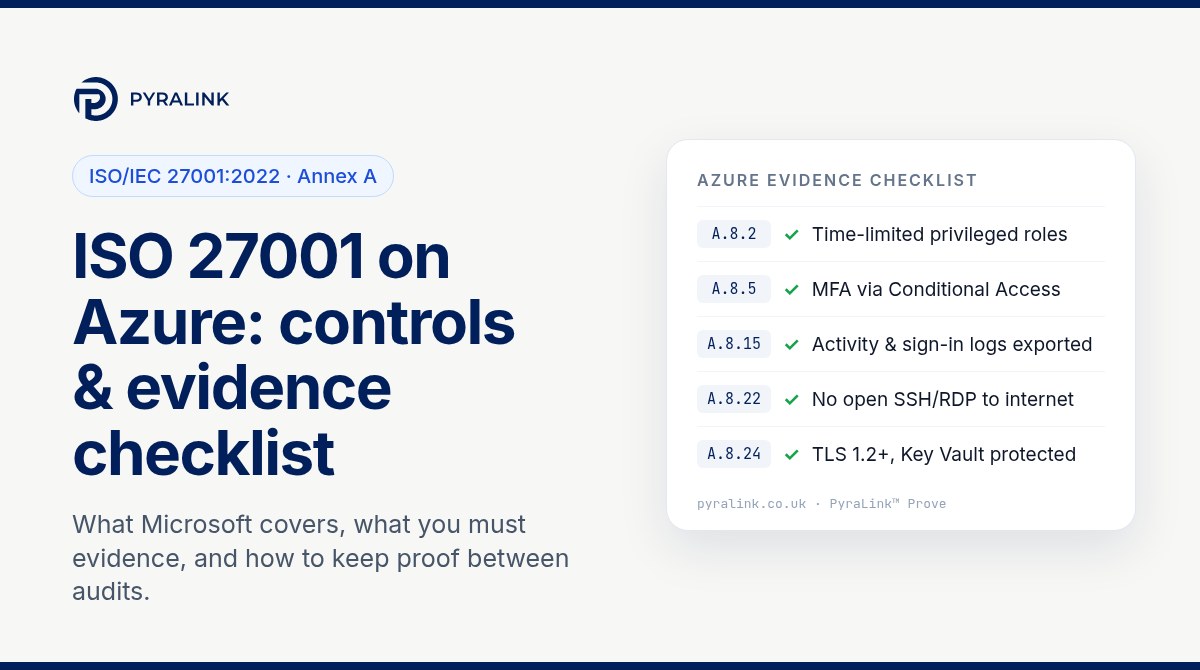
Short answer: hosting on Microsoft Azure does not make your organisation ISO 27001 compliant. Microsoft's ISO/IEC 27001 certificate covers the Azure platform it runs: data centres, physical security, the hypervisor and the operation of its managed services. Your certification body will audit the controls you own inside your tenant and subscriptions: who has access and how they sign in, what is exposed to the internet, how data is encrypted, whether activity is logged and actually reviewed, how changes are approved and whether backups can be restored. You also need to show they keep working between audits.
This guide explains the split of responsibility, then gives a control-by-control checklist of the Azure settings and records auditors usually sample against ISO/IEC 27001:2022 Annex A, with read-only commands you can run today.
What ISO 27001:2022 actually asks for
ISO/IEC 27001:2022 has two parts that matter here. Clauses 4 to 10 set out the management requirements: scope, risk assessment, risk treatment, internal audit and management review. Annex A lists 93 reference controls in four themes: organisational (37), people (8), physical (14) and technological (34). You choose the controls that treat your risks and record the decision for each one in a Statement of Applicability (SoA).
The transition period for the 2013 edition ended on 31 October 2025, so every current certificate and every new audit uses the 2022 control set. That matters on Azure because several 2022 controls are new and sit squarely in cloud territory: 5.23 information security for use of cloud services, 8.9 configuration management, 8.16 monitoring activities, 8.10 information deletion and 8.11 data masking.
The standard is technology-neutral: nothing in Annex A says "turn on Conditional Access". Your auditor samples controls from your SoA and asks you to show each one is working. On Azure, the most convincing answer is usually a dated configuration record pulled straight from the platform.
Shared responsibility: what Microsoft covers and what you own
Microsoft's shared responsibility model for the cloud is the starting point. Microsoft takes on more as you move from virtual machines to platform services, but identity, access, data, network exposure and configuration always stay with you.
Microsoft publishes its Azure ISO/IEC 27001 certificate and audit reports, which you can download from the Service Trust Portal. Keep the current copies in your supplier records. They are your evidence for the supplier controls (5.19 to 5.22) and part of your answer to 5.23, but they do not evidence a single control inside your subscriptions.
| Area | Microsoft | You |
|---|---|---|
| Data centres, hardware, physical access (Annex A 7.x) | Yes, for the Azure platform | Your own offices and devices |
| Identities, roles and sign-in policy | Provides Entra ID and Azure RBAC | Configures, reviews and evidences them |
| Network exposure | Platform network | NSGs, public endpoints, firewalls, private endpoints |
| Encryption | Encryption at rest on by default for many services | TLS settings, keys, Key Vault protection, your cryptography policy |
| Logging and monitoring | Produces platform logs | Exports, retains, alerts on and reviews them |
| Backup and recovery | Provides Azure Backup and redundancy options | Chooses policies and proves restores work |
Annex A controls and the Azure evidence auditors sample
The table below covers the Annex A controls where your Azure configuration is the evidence; people, physical and most organisational controls are evidenced by policies, records and interviews.
| Annex A control | What the auditor asks | Azure evidence |
|---|---|---|
| 5.15 to 5.18 Access control, identity, authentication information, access rights | Is access granted on need, reviewed and removed on time? | Entra ID user and group export, Azure RBAC role assignments per subscription, access review results, leaver tickets matched to disabled accounts |
| 8.2 Privileged access rights | Who can change production, and is that access time-limited? | Owner and User Access Administrator assignments, Privileged Identity Management eligible vs permanent roles, documented break-glass accounts |
| 8.5 Secure authentication | Is strong authentication enforced? | Conditional Access policies requiring MFA for all users and admins, legacy authentication blocked, exported sign-in logs |
| 5.23 Use of cloud services | How are subscriptions provisioned, governed and exited? | Management group hierarchy, subscription list with owners, Microsoft's certificate on file, exit and data-return plan |
| 8.9 Configuration management | What is your baseline and how do you spot drift? | Azure Policy assignments, compliance state over time, infrastructure-as-code repository as the approved baseline |
| 8.15 Logging, 8.16 Monitoring activities | Are events recorded, kept and reviewed? | Subscription Activity log diagnostic setting, Entra sign-in and audit log export, retention settings, alert rules and evidence alerts were triaged |
| 8.20, 8.22 Network security and segregation | What is reachable from the internet, and are environments separated? | NSG rules with no SSH or RDP open to any source, Azure Bastion or just-in-time access, separate virtual networks or subscriptions for production, private endpoints for PaaS |
| 8.24 Use of cryptography | Does practice match your cryptography policy? | Storage secure transfer and minimum TLS 1.2, Azure SQL transparent data encryption, Key Vault purge protection, customer-managed keys where your policy requires them |
| 8.8 Technical vulnerabilities | Are vulnerabilities found and fixed within your stated timescales? | Vulnerability assessment coverage for VMs and container images, findings with remediation dates |
| 8.13 Backup, 5.30 ICT readiness | Can you actually recover? | Recovery Services vault policies, soft delete enabled, dated restore test records |
| 8.32 Change management | Are production changes reviewed and approved? | Pull request approvals, pipeline deployment history, Activity log write operations, resource locks on critical resources |
Step-by-step: building the Azure evidence
1. Pin the scope to real subscriptions
Write down which tenants, management groups and subscriptions are in scope and why. A vague scope invites the auditor to sample anything, including a forgotten test subscription.
2. Baseline with read-only checks
Run these with an account that holds only the Reader role. They change nothing and give you a dated starting point.
# Who holds Owner or User Access Administrator, including inherited assignments
az role assignment list --all --include-inherited \
  --query "[?roleDefinitionName=='Owner' || roleDefinitionName=='User Access Administrator'].{who:principalName, type:principalType, role:roleDefinitionName, scope:scope}" -o table

# Is the subscription Activity log exported anywhere?
az monitor diagnostic-settings subscription list -o table

# Storage accounts: anonymous blob access, minimum TLS, HTTPS only
az storage account list \
  --query "[].{name:name, anonBlob:allowBlobPublicAccess, minTls:minimumTlsVersion, httpsOnly:enableHttpsTrafficOnly}" -o table

# NSG rules allowing inbound traffic from any source (also check sourceAddressPrefixes)
az network nsg list \
  --query "[].{nsg:name, open:securityRules[?direction=='Inbound' && access=='Allow' && (sourceAddressPrefix=='*' || sourceAddressPrefix=='Internet')].destinationPortRange}" -o json

# Key Vault purge protection
for v in $(az keyvault list --query "[].name" -o tsv); do
  az keyvault show --name "$v" --query "{vault:name, purgeProtection:properties.enablePurgeProtection}" -o tsv
done

# Azure Policy compliance summary for the current subscription
az policy state summarize --query "results.{resources:nonCompliantResources, policies:nonCompliantPolicies}"
Export Conditional Access policies and access reviews separately from the Microsoft Entra admin centre or Microsoft Graph, and keep the dated export.
3. Switch on the evidence you cannot recreate later
Logs are the one piece of evidence you cannot produce retrospectively. The Azure Activity log is kept for 90 days by default, and Entra ID sign-in and audit logs for 7 days on the free tier or 30 days on P1 and P2. If your retention commitment is a year, export both to a Log Analytics workspace or storage account now, and set retention to match what your policy says.
4. Assign the ISO 27001:2022 policy initiative, then read it critically
Azure Policy includes a built-in ISO/IEC 27001:2022 regulatory compliance initiative, which you can assign at management group or subscription level in audit mode and view in Microsoft Defender for Cloud. Microsoft describes it as only a partial view of compliance. Treat a green control as "no policy failure found", not "control implemented".
5. Fix, then prove the fix held
Record each finding with an owner and target date. After the fix, re-check the resource rather than closing the ticket on trust, and keep the dated result. That record feeds your corrective action log under clause 10 and is what an auditor wants at the first surveillance audit.
6. Assemble the pack before Stage 2
Group the evidence by SoA control, not by Azure service: a folder per control with dated exports is far easier to sample than portal screenshots.
Issues that often come up on Azure audits
- Standing Owner rights for engineers who only need them during incidents, instead of time-limited elevation.
- Guest accounts from past suppliers still holding production roles.
- Activity log retained only for the default 90 days, so the sampled period cannot be shown.
- An "allow any" NSG rule left behind after troubleshooting.
- Backups configured but never restored, leaving 8.13 and 5.30 asserted rather than evidenced.
- Copies of production data in development subscriptions with no masking or deletion process, which touches 8.10, 8.11 and 8.33.
The NCSC Cloud Security Principles are a useful cross-check for the same areas.
Running workloads on AWS as well? The same Annex A approach, mapped to IAM, CloudTrail, AWS Config and KMS, is in our ISO 27001 on AWS checklist.
Reusing the evidence for other frameworks
Most of these records also answer SOC 2 and Cyber Essentials questions. For AWS, our SOC 2 on AWS controls and evidence checklist covers the same ground there, and multi-cloud compliance auditing explains how to collect evidence once and map it to several frameworks. For the management side of certification, from scoping to Stage 2, see our ISO 27001 readiness roadmap for UK organisations. For the identity and network design behind 8.2, 8.5 and 8.22, read applying the NCSC's zero trust principles to Microsoft 365, Azure and AWS.
Where PyraLink Prove fits
PyraLink™ Prove connects to Azure, AWS and Google Cloud with read-only access that you grant and can revoke, with no agents on your servers, and checks Microsoft 365 read-only as well, including administrative roles and Conditional Access. Its checks are mapped to ISO/IEC 27001:2022 alongside SOC 2, Cyber Essentials, NIS2, DORA and the CIS Microsoft Azure Foundations Benchmark, so one observation can support several frameworks. Results are kept as digitally signed, dated evidence records that you can verify independently, so you can show an auditor what a control looked like on a given date. When a fix is applied, PyraLink Prove re-checks the affected resource and reopens the ticket if the issue is still there.
PyraLink Prove does not issue ISO 27001 certificates, and it does not replace your SoA, risk assessment or policies. It focuses on the technical cloud evidence; the certification decision stays with your certification body. If you are weighing options, see how PyraLink Prove compares with Vanta, Drata and Wiz.
Shortlisting a broader compliance platform as well? Our Vanta vs Drata comparison for UK teams sets out what each vendor publishes and what to test in a demo.
Frequently asked questions
Does Microsoft hold an ISO 27001 certificate for Azure?
Microsoft holds an ISO/IEC 27001 certificate covering Azure and many of its services, and publishes the certificate and audit reports on the Service Trust Portal. That covers Microsoft's platform, not your use of it: your own certification body audits the controls inside your tenant and subscriptions.
Does the Azure Policy ISO 27001 initiative make us compliant?
No. The built-in ISO/IEC 27001:2022 initiative maps some Annex A controls to technical policy checks. Microsoft describes it as a partial view. It is useful evidence for configuration controls, but many controls depend on policies, records and people that no policy can test.
Which Annex A controls depend most on Azure configuration?
Mainly the access controls (5.15 to 5.18, 8.2, 8.5), configuration management (8.9), logging and monitoring (8.15, 8.16), network security (8.20, 8.22), cryptography (8.24), vulnerability management (8.8), backup (8.13) and change management (8.32), plus 5.23 for cloud services.
How long should we keep Azure logs for ISO 27001?
The standard does not set a period. Keep logs for as long as your own policy and risk assessment say, and long enough to cover the period an auditor will sample. Azure's defaults (90 days for the Activity log, 7 or 30 days for Entra ID logs) are usually too short, so export them.
Can PyraLink Prove issue an ISO 27001 certificate?
No. Only an accredited certification body can certify your organisation. PyraLink Prove collects digitally signed, dated technical evidence from Azure, AWS and Google Cloud, mapped to ISO/IEC 27001:2022, that you can share with your auditor.
Sources: Microsoft Learn: ISO/IEC 27001 Azure compliance offering; Microsoft Learn: Shared responsibility in the cloud; NCSC: Cloud Security Principles.